Choosing an umbrella company: how to check accreditation, payslips and deductions

If an agency has sent you a shortlist of umbrella companies and asked you to pick one by the end of the week, the quickest way to tell them apart is not the take-home figure in the sales email. It is the paperwork behind it.
Umbrella companies employ contractors and freelancers on behalf of recruitment agencies and end clients, process timesheets and pay a salary through PAYE. Most contractors encounter them because a role has been assessed as inside IR35, which rules out working through their own limited company.
Since 6 April 2026, responsibility for accounting for PAYE on umbrella payments has shifted onto the agency in the labour supply chain, a change confirmed in the Autumn Budget 2024. That has already narrowed the market in places, because agencies now carry the risk if an umbrella fails to pay the tax over.
Here is how to test any provider on your shortlist, and what the rules now require.
What the umbrella actually does with your rate
The umbrella becomes your employer for the duration of the assignment. The agency pays it an assignment rate for your work, and it pays you a salary through PAYE with income tax and employee National Insurance deducted.
As an employee you are entitled to statutory holiday pay, statutory sick pay, statutory maternity and paternity pay, and auto-enrolment into a workplace pension if you meet the earnings and age criteria. Holiday pay is normally accrued at 12.07% of gross pay, either held and paid when you take leave or rolled up and paid each period where that is permitted.
Providers such as DASA Umbrella operate on this model, taking contractors on as employees for the length of an assignment and running weekly or monthly payroll. The structure itself is long established and has been used in the UK contracting market for decades, which is part of why compliance standards vary so widely between operators.
Why the assignment rate is not your gross salary
This is the single biggest source of confusion for first-time umbrella workers.
The assignment rate is the amount the agency pays the umbrella. Before your gross pay is calculated, the umbrella deducts the employment costs it has to fund from that rate. They include:
- employer's National Insurance, charged at 15% on earnings above the secondary threshold of £5,000 a year since April 2025
- the apprenticeship levy, charged at 0.5% of an employer's pay bill above the £3m annual allowance, which most large umbrella payrolls exceed
- the provider's own margin, which should be a fixed fee per pay period rather than a percentage of your rate
The levy is frequently the line contractors query first, because it appears on the payslip without any obvious connection to the worker. In practice it is an employer cost that umbrella companies fund from the assignment rate in the same way as employer's National Insurance.
Here is how a month at £400 a day for 20 days might break down at the employment cost stage. The figures are illustrative and assume a £100 monthly margin:
| Line | Amount |
|---|---|
| Assignment rate received from agency | £8,000.00 |
| Umbrella margin | £100.00 |
| Employer's National Insurance | £971.59 |
| Apprenticeship levy | £34.47 |
| Gross pay, including holiday pay | £6,893.94 |
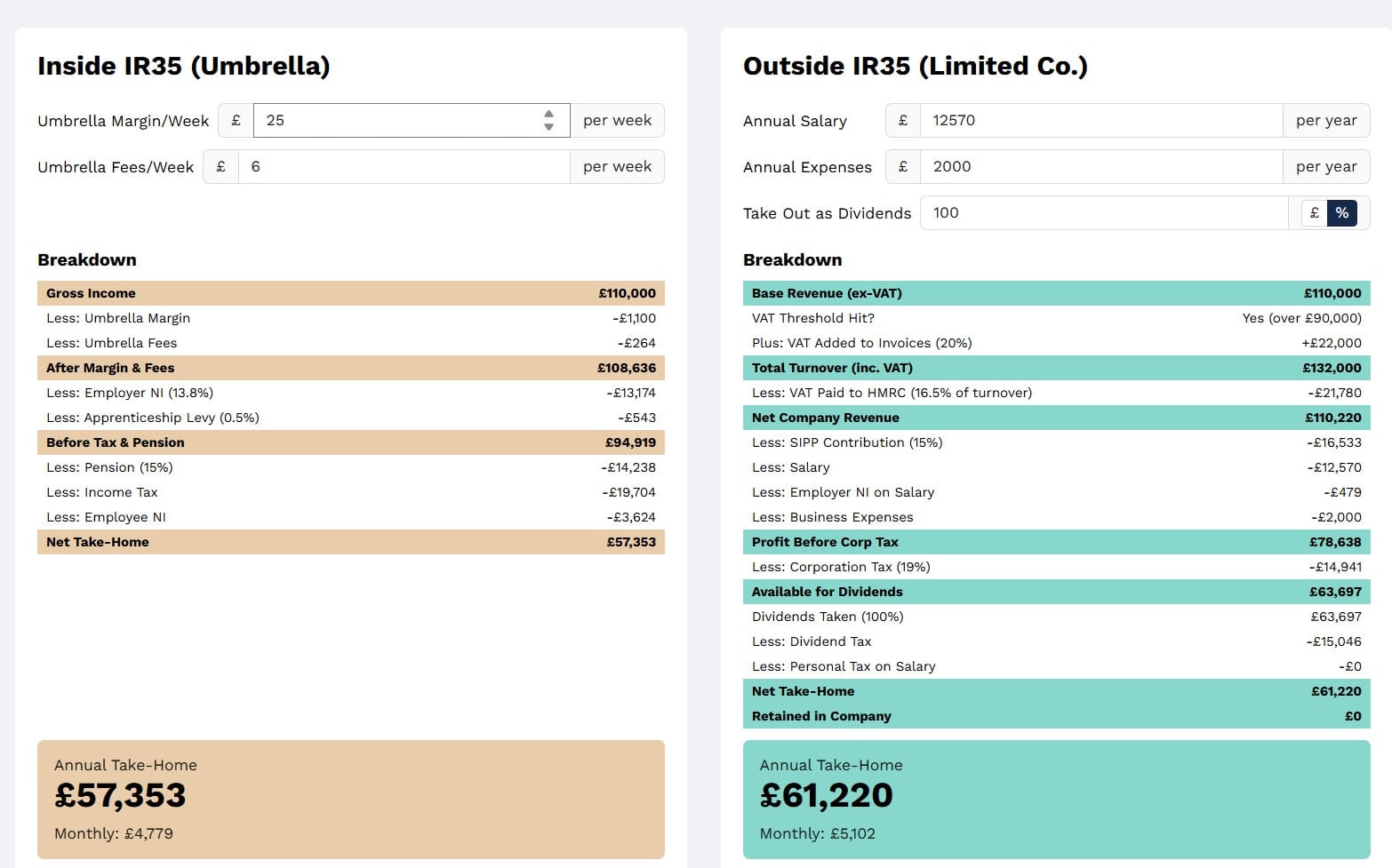
Income tax, employee National Insurance and any pension contributions then come out of that gross figure. If you want to model your own numbers, our umbrella take-home calculator covers the 2026/27 tax year and let you vary the rate, margin and pension input.
Accreditation narrows the list, but it does not price the deal
Two independent schemes dominate umbrella accreditation in the UK. The Freelancer and Contractor Services Association assesses members against tax and employment compliance standards and publishes a member directory. SafeRec runs automated audits of umbrella payroll data, comparing payslips against what has actually been reported to HMRC.
Neither badge is a legal licence, and neither tells you whether the margin is competitive or whether the support team answers the phone on a Friday afternoon. What they do give you is a documented compliance check by someone other than the provider's own marketing department.
Treat logos with caution. Search the provider's exact registered name in the relevant directory, then compare that name against the company named on your employment contract and the company number registered at Companies House. Where the three do not match, that discrepancy is worth resolving before you sign anything.
Ask for a sample payslip at your actual rate
A generic illustration is close to useless. Ask each shortlisted provider for a sample payslip calculated at your real day rate, your expected hours and your tax code.
Agencies have also been required since 6 April 2020 to issue a Key Information Document before you start work, setting out the rate, deductions and who pays you. Reading the two documents side by side is the fastest way to spot a gap.
A clean umbrella payslip shows, as separate and labelled lines:
- the assignment rate received from the agency, so you can see where the money started
- the umbrella margin as a fixed amount per pay period
- employer's National Insurance and apprenticeship levy, grouped as employment costs
- gross pay and holiday pay, with the holiday element identified as accrued or paid
- income tax, employee National Insurance and any pension contribution
- net pay
If a figure appears in the sales illustration but not on the sample payslip, ask where it has gone. Reputable providers will answer in writing.
Deduction lines that should prompt questions
A noticeably higher take-home figure on an identical assignment rate has to come from somewhere, and the usual source is tax that is not being paid.
Watch for any part of your pay described as a loan, advance, credit facility, annuity, grant or bonus that does not pass through PAYE. Arrangements of that kind sit behind the loan charge, which left large numbers of contractors facing settlement demands years after they joined schemes they believed were compliant.
A second pattern is the mini umbrella model, where your payslips come from a succession of small companies that change every few months. HMRC has warned employment agencies and workers about this structure, which abuses the employment allowance and VAT flat rate scheme.
There is also an expenses question. Since April 2016, workers subject to supervision, direction or control, or the right of it, cannot claim home to work travel and subsistence as a tax deduction through an umbrella. Most agency placements fall within that restriction, so a provider promising substantial expense savings is either misapplying the rules or relying on you not checking.
What changed for umbrella pay in April 2026
The Autumn Budget 2024 confirmed that recruitment agencies, or the end client where no agency sits in the chain, would become responsible for accounting for PAYE on payments made through umbrella companies. Industry coverage at the time set out how the processing obligation would move up the supply chain from April 2026, rather than removing umbrellas from the market.
The practical effect is a liability transfer. Accountancy commentary at the time noted that recruiters would be exposed to the tax debt if an umbrella failed to pay, which is a materially different risk position from the one agencies held before.
For contractors, the consequences are mixed. Supplier vetting has tightened, and accredited providers are more likely to survive a preferred supplier list review. Against that, choice has narrowed. Some agencies now work with only two or three umbrellas, and you may not be able to carry over the provider you used on a previous contract.
Where no agency is involved and the end client pays the umbrella directly, the obligation falls on the client. Smaller clients and direct engagements are the area where the position is most likely to vary, so it is worth confirming in writing who is accounting for the PAYE on your assignment.
Scottish taxpayers see a different net figure
If your main home is in Scotland, Scottish income tax rates and bands apply to your employment income, while National Insurance remains UK wide. Two contractors on the same assignment rate, employed by the same umbrella, can therefore take home different amounts depending on where they live.
Umbrella calculators do not always default to Scottish rates, so check the assumption before comparing providers.
Umbrella, agency PAYE or limited company
The right structure depends on the IR35 status of the work rather than on the umbrella market itself. Since the off-payroll rules extended to the private sector in April 2021, medium and large clients determine status.
| Route | Who employs you | Admin burden | Typically used for |
|---|---|---|---|
| Umbrella | The umbrella company | Low, submit timesheets | Inside IR35 roles, short or back to back contracts |
| Agency PAYE | The agency itself | Lowest | Where the agency offers direct PAYE and you want fewer parties involved |
| Limited company | Your own company | High, accounts, filings and usually an accountant | Work genuinely outside IR35, often with multiple clients |
A limited company does not improve the tax position on work that has been determined inside IR35. Where the determination is contested, the route to challenge it is the client-led disagreement process rather than the choice of payroll provider.
Questions worth putting to each provider
How much does the umbrella take from my pay? The margin is set by the provider and should be a fixed amount per pay period. Employer's National Insurance and the apprenticeship levy also come out of the assignment rate, which is why gross pay is always lower than the headline rate.
Can I claim expenses? Only in limited circumstances. Where supervision, direction or control applies, home to work travel and subsistence are not deductible.
How do I verify the provider is legitimate? Check the accreditation directories, match the trading name and company number against Companies House, and confirm after your first payday that the tax and National Insurance deducted appear in your HMRC personal tax account.
What happens to my holiday pay? Ask whether it is accrued and held, or rolled up and paid each period, and how to claim accrued pay if the assignment ends.
The test, in order
Accreditation first, because it removes the weakest candidates quickest. Then the sample payslip at your real rate. Then the deduction lines, particularly anything that bypasses PAYE. Then confirmation of who is accounting for the PAYE under the rules now in force.
The provider that answers all four in writing, within a day, has told you most of what you need to know about how it will behave when something goes wrong on week six.